

Edition #147
Investing Unlocks: How to Capitalize on the Hot Topics From The Last 7 Days
We analyze recent trends and opportunities, offering strategic insights that help you manage risks and identify growth opportunities for your portfolio.
🛢️ Oil Shock Rattles Markets
U.S. stocks slid last week, as investors grappled with a sudden spike in oil prices and signs of a softer labor market. Escalating conflict in the Middle East disrupted shipping through the Strait of Hormuz, sending crude sharply higher and reigniting inflation fears. At the same time, the February jobs report showed an unexpected 92,000 job loss, raising concerns that economic momentum may be weakening. Energy stocks gained while travel, banking, and tech lagged, pushing the S&P 500 and Nasdaq to their worst weekly performance in months.
The coming week centers on inflation data and labor market signals. The Feb CPI report arrives Wed, Mar 11, a key read on whether rising energy prices are feeding into broader inflation, while JOLTS job openings land Fri, Mar 13. Markets will also watch oil prices and geopolitical headlines, which are already driving volatility and complicating the Federal Reserve’s rate outlook.
PRESENTED BY CANTERRA MINERALS CORP.

Canterra Minerals (TSX-V: CTM, OTCQB: CTMCF) is advancing a fully-funded 10,000-metre drill program across its 55 km copper-gold corridor in Newfoundland.
Get all the details in our in-depth investor guide.
Download the Exclusive Investor Report.
Hot Topics
G7 nations to hold emergency meeting on oil as stock markets sink
Emerging Valuations in Prediction Market Platforms Kalshi and Polymarket
Google’s Commitment to Anthropic AI Models Amid Pentagon Concerns
North American IPO Activity
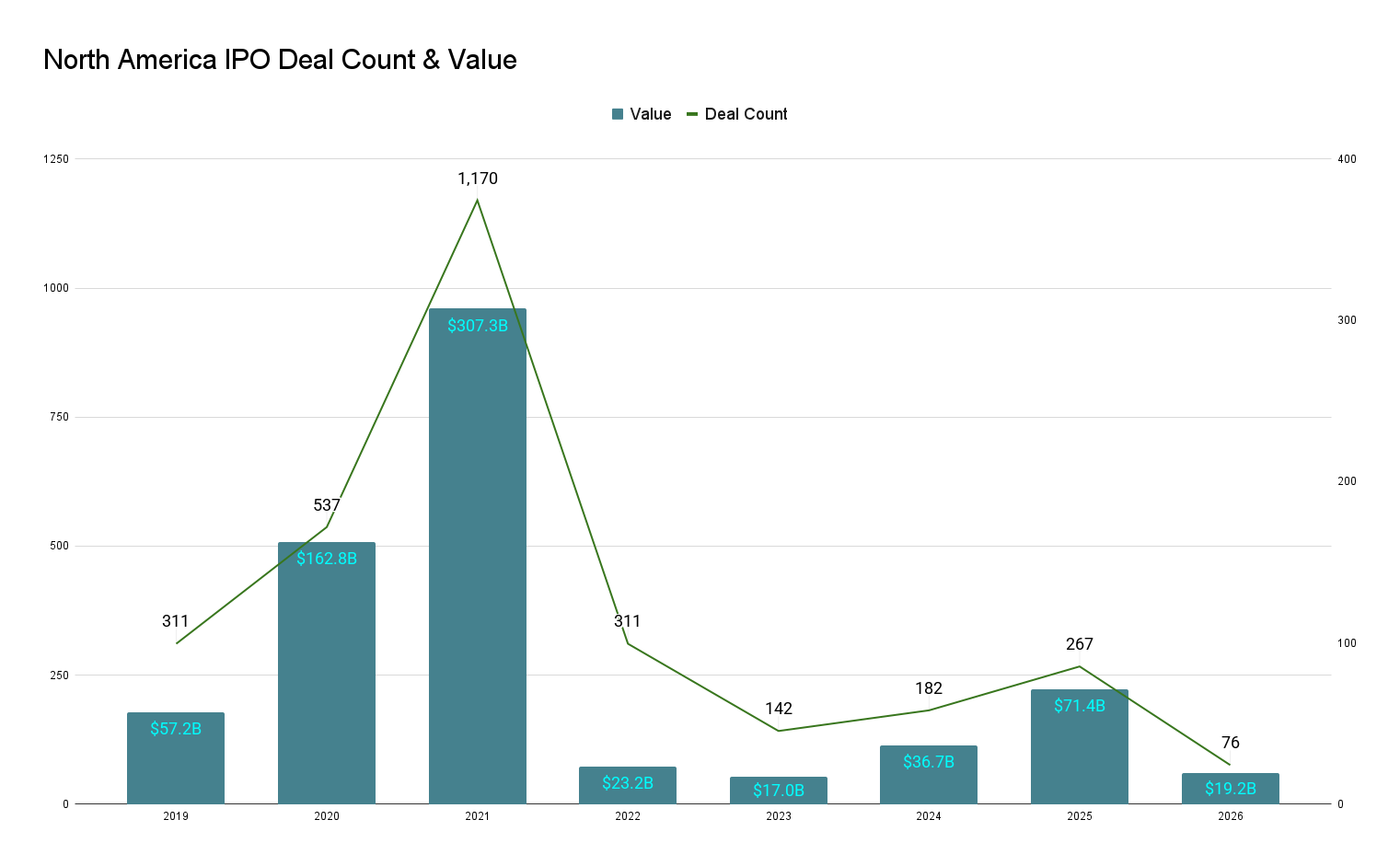
The chart shows a classic boom-bust-recovery cycle for North American IPOs over the past several years. Both deal value and deal count surged during the pandemic era, collapsed in the tightening cycle of 2022–2023, and are now showing early signs of recovery.
Listings surged from 2019 through 2021 as ultra-low interest rates, strong equity markets, and abundant liquidity fueled demand for growth companies. By 2021, the market hit a historic peak, with more than 1,100 deals raising over $300B.
Then the window slammed shut.
Aggressive rate hikes in 2022 crushed valuations and risk appetite, forcing many companies to delay going public. IPO activity collapsed through 2023 before beginning a modest recovery in 2024 and 2025.
Now Wall Street is betting on a stronger revival. Goldman Sachs estimates U.S. IPO proceeds could reach roughly $160B in 2026 if market conditions hold.
Much of that momentum may depend on a few blockbuster listings. Potential mega IPOs include OpenAI, which could debut at a valuation approaching $1T, and SpaceX, Elon Musk’s private rocket and satellite company.
Oil Price Fears
A rising price of oil affects almost everything in the global economy, increasing transport costs, manufacturing costs, and ultimately the price consumers pay for goods and energy.
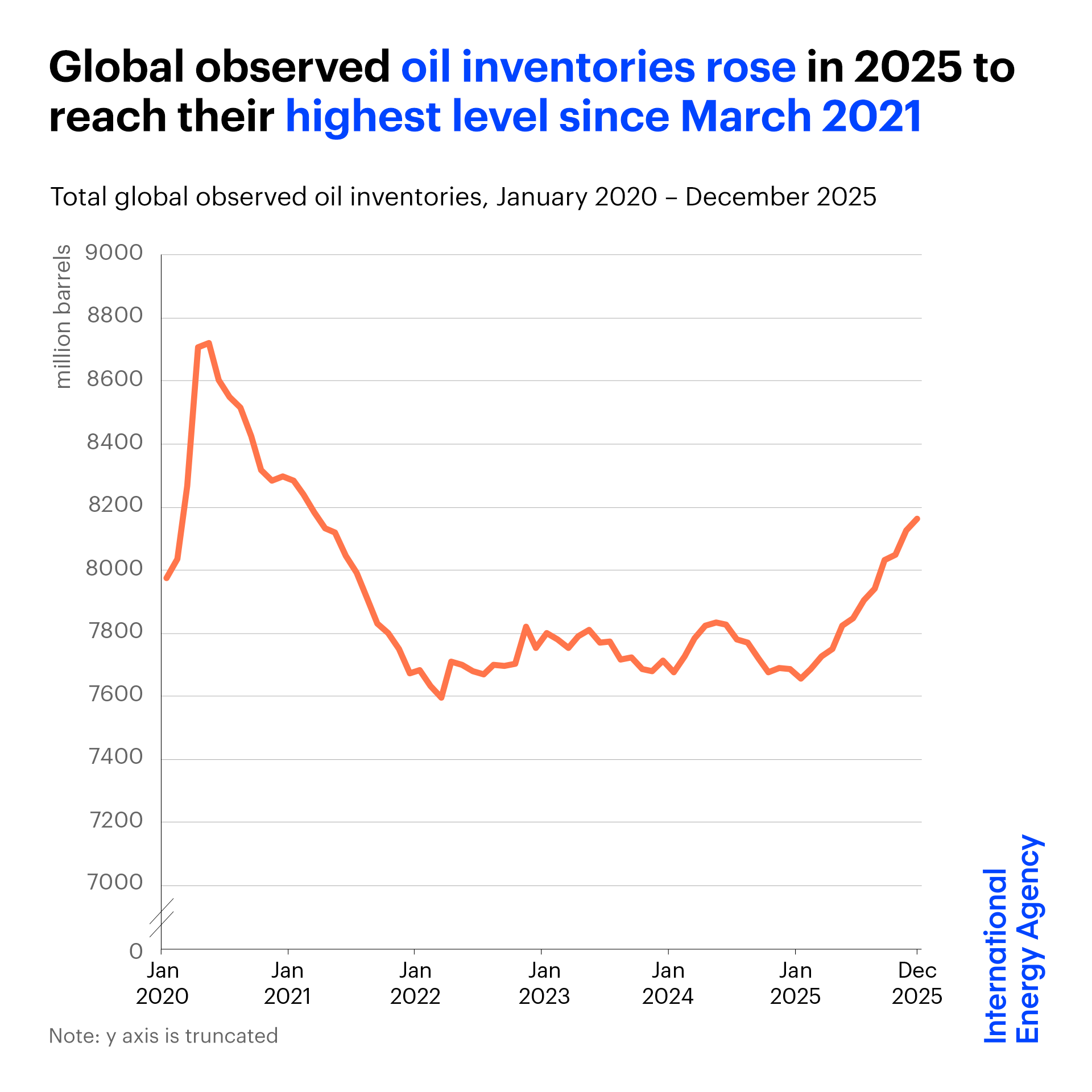
That is why the jump in oil above $110 has rattled markets. The surge reflects fears around disruption in the Strait of Hormuz, not an immediate shortage of crude. In fact, global oil inventories are currently very high, more than 8.2 billion barrels, the largest stockpile since early 2021.
If Hormuz becomes impassable, these reserves could be released in a coordinated effort to stabilise supply, mainly flowing into the US, Europe, and parts of Asia through existing infrastructure. But those stockpiles can only cushion the shock. Around 20% of global oil supply normally passes through Hormuz, so a prolonged closure would still tighten the market and push prices higher.
The bigger risk is if the conflict spreads to critical infrastructure. Direct strikes on Gulf oil and gas facilities would remove supply from the market, while damage to desalination plants or power systems could also disrupt production. In that scenario, the current price spike could evolve into a more sustained global energy shock.
Earnings Performance
Costco Wholesale Corp (NASDAQ: COST)
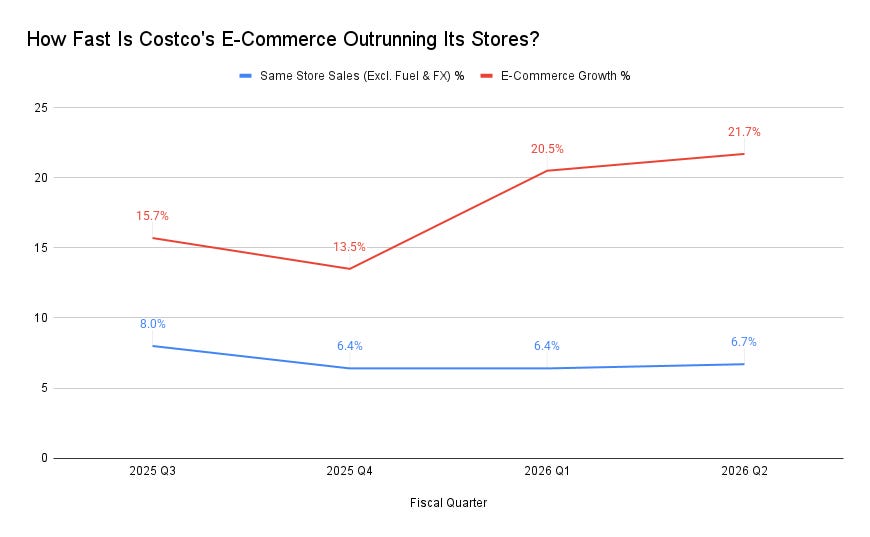
How fast is Costco’s e-commerce outrunning its stores?
Costco’s e-commerce business is growing much faster than its warehouse stores.
In Q2 2026, digitally enabled comparable sales rose 22.6% (or 21.7% excluding fuel and currency impacts), compared with 7.4% (or 6.7% excluding fuel and currency impacts) overall comparable sales growth. The trend was similar in Q1 2026, when digitally-enabled comparable sales climbed 20.5% versus 6.4% overall. Monthly figures also show strong momentum, with digital sales up 33.1% in January 2026.
Over the longer term, however, Costco’s online growth has trailed some competitors. UBS estimates its e-commerce sales have grown at an 18% annual rate since 2017, compared with about 27% for rivals like Walmart, Target, and Kroger.
Management has highlighted investment in personalised recommendations and improved product pages as driving stronger digital engagement.
Other Earnings Updates
Marvell Technology Inc (NASDAQ: MRVL): Reports Strong Q4 Earnings
Canadian Natural Resources (NYSE: CNQ): Sees 15% Production Surge
Ross Stores, Inc. (NASDAQ: ROST): Beats Q4 EPS, Raises Dividend 10%
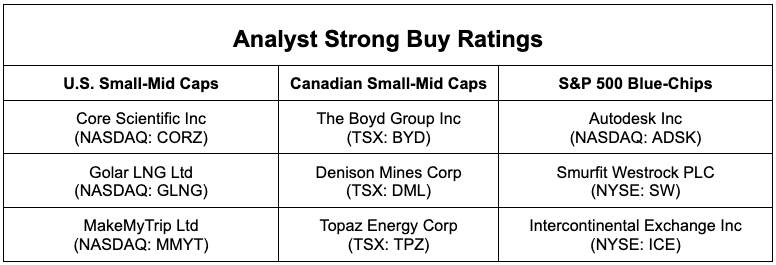
Analyst Strong Buy Ratings This Week! 📈
Looking for stocks with strong analyst backing? These companies have earned top-tier "Strong Buy" ratings from analysts, signaling potential upside for investors.
Whether you’re eyeing small-to-mid cap opportunities in the U.S. and Canada or want to stick with trusted S&P 500 blue-chip picks, this list highlights stocks that experts believe could outperform.
🔍 Do your research and see if any of these fit your portfolio!
Druckenmiller’s Playbook, Decoded
Stan Druckenmiller told Morgan Stanley’s Hard Lessons podcast in January that AI no longer drives Duquesne’s portfolio, and what replaced it is telling.
Druckenmiller described a current book built around copper futures, gold, Japanese and Korean equities, and a short on US bonds as inflation insurance. The AI exposure that dominated Duquesne for three years is now “drips and drabs.” The catalyst for the shift: last summer, the sector started rhyming with 1999.
His replacement trade was Teva Pharmaceuticals, bought at $16 and six times earnings when CEO Richard Francis was executing a pivot from generics to biosimilars. Value investors hated the growth strategy; growth investors hadn’t yet bought the transition. By January, the stock had doubled to $32 and re-rated to roughly 12x earnings.
On the dollar, he’s outright bearish, not on a “sell America” thesis, but because foreign investors are overloaded in dollar assets and the currency sits near the top of its historical purchasing-power range. On copper, he admits it’s a popular trade, but holds it on supply constraints through 2032 and AI data centre demand.
He openly flags that a Fed rate cut into a strong economy could reignite inflation, precisely the scenario his short bond position is designed to hedge, not predict.
Druckenmiller’s rotation out of AI concentration and into copper, biotech, and non-dollar assets over an 18-month to three-year horizon may signal where the next multi-year opportunities are quietly forming.